
 Call Today! 419-836-1033
 3601 Ayers Road | Millbury, OH 43447
 You caught a glimpse of something in the mirror. A spot on your tooth that wasn’t there before, or at least one you never noticed. Now you’re wondering what a cavity looks like and whether that spot is one.
Here’s the short answer. A cavity usually starts as a chalky white patch on the enamel, darkens to yellow, brown, or black as the decay deepens, and can eventually become a visible hole or pit in the tooth. Many cavities, though, are completely invisible in a mirror. That’s why dentists rely on exams and X-rays instead of eyesight alone.
Knowing what to look for helps you catch trouble early, when fixing it is quick and painless. Here’s what a cavity looks like at each stage, how to tell one from a harmless stain, and when a spot deserves a professional opinion.
What Does a Cavity Look Like in Its Early Stages?
An early cavity looks like a chalky, matte white spot on the tooth, often near the gumline or on a smooth front surface. It’s painless, easy to miss, and not yet a hole. At this stage the damage is still reversible, and fluoride can often repair the enamel before a true cavity forms.
Dentists call these white spot lesions. They happen when acids from plaque bacteria pull minerals out of your enamel, a process called demineralization. The surface is still intact, but it’s weakened, and it loses the glossy shine of healthy enamel. That flat, chalky look is the giveaway.
This is the stage where the news is genuinely good. Caught here, a cavity can often be stopped with fluoride treatments, better brushing habits, and some changes to snacking patterns. No drill, no filling. The catch is that white spots hide easily, especially on back molars, which is one reason regular checkups pay for themselves.
What Color Is a Cavity?
Cavities follow a color progression as they deepen: chalky white first, then yellow, then brown, and finally black in advanced decay. Color alone can’t confirm a cavity, though. Some dark grooves on molars are harmless stain, while a small brown dot can hide a much larger soft spot underneath the surface.
Think of color as a rough timeline. The darker the spot, generally, the longer the decay has been working. On front teeth, a cavity may show as a white patch that slowly turns light brown. On molars, decay most often shows up as brown or black spots settled into the deep grooves of the chewing surface.
What color can’t tell you is depth. Dentists confirm a cavity by texture, not shade. Decayed enamel feels soft or sticky when checked with an instrument, while stained but healthy enamel stays hard. If you’ve noticed black lines on your teeth, those are usually stain rather than decay, though they deserve a look to rule out trouble.
How Can You Tell a Cavity From a Stain?
Stains sit on the surface, tend to appear across several teeth at once, and stay stable over time. A cavity is usually a single spot on one tooth that grows over weeks or months, may feel rough or sticky to your tongue, and often brings sensitivity along with it.
Coffee, tea, red wine, and tobacco are the usual staining suspects, and they rarely limit their work to one tooth. Decay behaves differently. A few contrasts make the call easier:
- Location – stains spread across multiple teeth, while a cavity is typically one distinct spot
- Change – stains hold steady, while cavities grow and darken over time
- Texture – stains feel smooth under your tongue, while a cavity may feel rough, soft, or sticky
- Sensation – stains never hurt, while a cavity often becomes sensitive to sweets, heat, or cold
A stain will never cause you pain. A cavity eventually will. If a spot twinges when you sip something cold or bite into something sweet, stop debating stain versus cavity and get it checked.
Can You Have a Cavity You Can’t See?
Yes, and it happens all the time. Cavities that form between teeth, under old fillings, or below the gumline are invisible in a mirror. These hidden cavities are usually found on dental X-rays, often before they cause any pain at all, which is exactly what you want.
A cavity in between teeth, which dentists call an interproximal cavity, forms in the tight contact point where a toothbrush can’t reach and only floss does the cleaning. You won’t see it. Often you won’t feel it until it’s deep. The same goes for decay creeping under the edge of an aging filling.
This is why a clean mirror check isn’t the same as a clean bill of health. Modern digital X-rays reveal decay between teeth and under restorations while it’s still small, using a fraction of the radiation of older film systems. Waiting until a cavity is big enough to see usually means waiting until it’s bigger, deeper, and more expensive to fix.
What Happens if a Cavity Is Left Untreated?
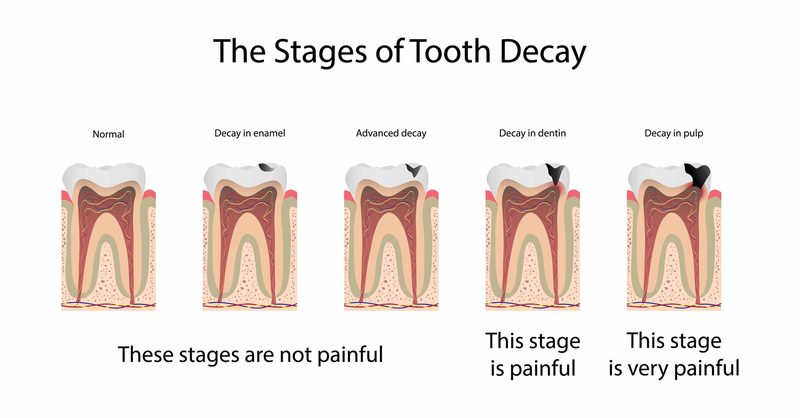
An untreated cavity keeps growing. It works through the outer enamel into the softer dentin underneath, where it spreads faster, and eventually reaches the nerve at the center of the tooth. What starts as a quick tooth-colored filling can become a crown, or a root canal, given enough time.
The frustrating part is how quiet the process is. Enamel has no nerves, so early decay is painless. Sensitivity usually starts once decay reaches dentin, and real pain arrives when it nears the pulp. Pain is a late signal, not an early warning.
Treatment at the early stages is genuinely routine. A modern cavity filling is typically a single visit: the decayed portion is removed, and the tooth is restored with a composite material matched to your natural tooth color. Most patients are back to their day within the hour. The earlier the catch, the smaller the filling and the more of your natural tooth you keep.
When Should You See a Dentist About a Spot on Your Tooth?
See a dentist about any spot that is new, growing, feels rough or sticky, or comes with sensitivity to sweets, heat, or cold. And keep up regular exams even when everything looks fine in the mirror, because many cavities form in places you simply cannot see.
Those rules cover the spots you can see. The ones you can’t are the better argument for consistency. Twice-yearly checkups and preventative dental care catch decay at the white spot stage, when reversing it is still on the table, and X-rays find the hidden cavities before they announce themselves with a toothache.
In most cases, a spot on a tooth turns out to be something minor. But guessing has a cost, because the difference between a stain and a cavity is a question of what’s happening beneath the surface, and only an exam can answer it.
Wondering about a spot on your tooth? Walbridge Dental has cared for families in Millbury and the surrounding Northwest Ohio communities for more than 50 years, and we’re happy to give you a straight answer. Call 419-836-1033 to schedule an exam and stop guessing.

Do You Have Dental Health Questions? Schedule an Appointment!
We want to help keep your smile healthy! If you have dental health concerns or are just looking for information, the professionals at Walbridge Dental provide complete family dental care to families in the Millbury community and the local Wood County, Ohio area. Contact us online to set up an appointment now or call us at 419-836-1033.
Connect on Social Media!